
How I Built a Personal Board of Directors With GenAI
Want a group of advisers who are always available — and challenge you in wise and unexpected ways? Consider composing a personal board using virtual personas modeled after current and historic figures and executives.
Carolyn Geason-Beissel/MIT SMR | Getty Images
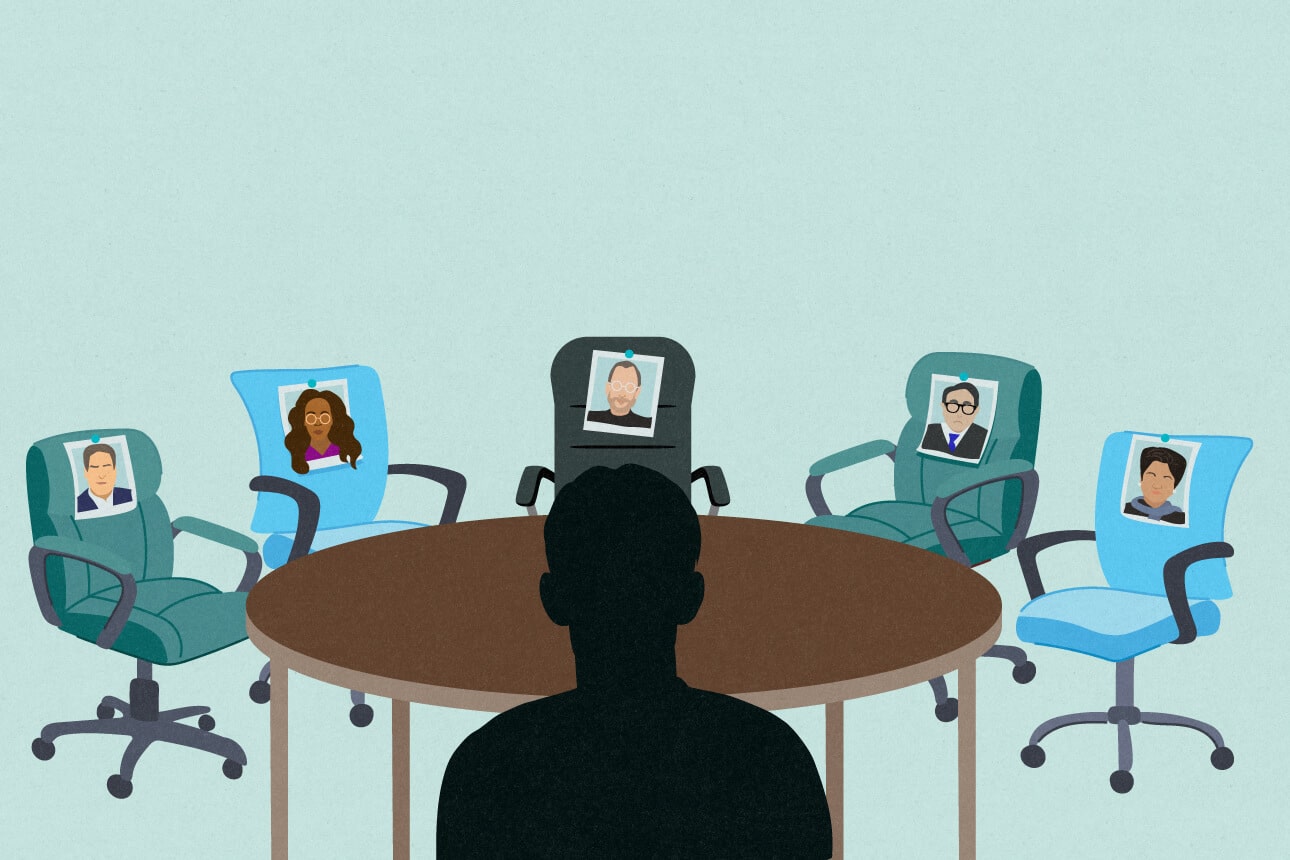
Using GenAI tools, leaders can construct a virtual, personal board of directors made of personas modeled after current and historic thinkers and strategists. Author Vipin Gupta has made an MVP Board based on leaders including Steve Jobs, Indra Nooyi, and Nelson Mandela. Each virtual adviser offers distinct perspectives on strategy, innovation, ethics, and operations questions. Combined with your human relationships, your own virtual board would form a hybrid team of advisers.
Leadership experts have long championed the concept of a personal board of directors as a way for executives to surround themselves with a circle of trusted mentors, sponsors, and advisers. I’ve advocated for and practiced this model myself during the past several years. But here’s the twist: What if your board members didn’t have to be real people? With the rise of generative AI (GenAI), every leader can build a personal board of directors composed of virtual personas modeled after some of the greatest thinkers, strategists, creators, and operators in history. This isn’t science fiction. It’s a modern, scalable way to access world-class insight and clarity on demand. And I’ve built one.
Traditionally, a personal board includes former managers, trusted peers, and friends — people who offer honest feedback and diverse perspectives. These relationships differ from mentorships and sponsorships: Mentors guide, and sponsors advocate, while boards challenge and provide advice.
But real-world personal boards are hard to maintain. They require time, energy, and availability — luxuries not always in abundance. I found myself yearning for a broader, more flexible perspective. That’s when I turned to AI. Generative AI provides the ability to simulate, customize, and scale advisory insight through persona modeling and prompts.
My virtual advisers don’t replace real people in my life, but they’re always available, always sharp, and never afraid to challenge conventional thinking. Combined with my real-life advisers, this virtual board of directors forms a powerful, hybrid brain trust.
Meet My Virtual Personal Board of Directors
One aspect of virtual boards is that they are not limited by geography, networks, or schedules. I built a team of AI-powered advisers, each modeled after an iconic leader — real or archetypal — with a distinct leadership lens and personality. I refer to this collective as My Virtual Personal Board of Directors (MVP Board).
To build my MVP Board, I first identified where I needed a consistent perspective across the core leadership domains: strategy, innovation, ethics, systems, and storytelling.
I selected iconic figures who embodied excellence and diverse thinking styles among those disciplines. Using ChatGPT, I created virtual identities with defined roles, mindsets, and challenge prompts to simulate dialogue through structured reflection. The MVP Board is not static. I’ve added new voices and rotated out others. This adaptability is part of its long-term power.
Comments (5)
Oleksii Badika
Sonali Shetty
Andy Dahl
Walter Adamson
Martin Williams